
Keeping solar panels clean protects output and extends system life. Dust, bird droppings and grime reduce sunlight to cells and lower generation. This guide summarizes the professional tools and techniques—from water-fed brushes to automated robots—so you can weigh efficiency, risk and cost and choose the right solution for each site.
Which Commercial Equipment Is Most Effective for Cleaning Solar Panels?
Choices depend on site size, local soiling and budget. Below are the main tools used on utility, commercial and rooftop installations and the strengths that make each practical for professional maintenance.
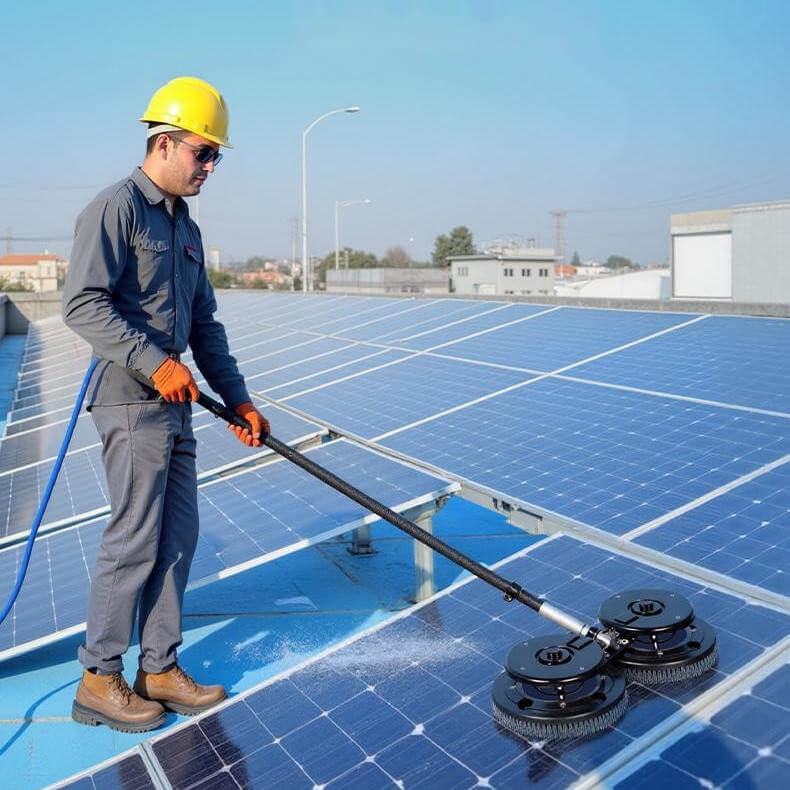
- Water-Fed Brushes: Use purified or deionized water to avoid mineral streaks. Operable from the ground with telescopic poles, they’re a safe, effective option for routine maintenance.
- PV Cleaning Robots: Autonomous or semi-autonomous robots provide repeatable cleaning across large arrays, cutting labor and improving uniformity on utility and commercial sites.
Get a Custom Solar Panel Washing Machine Quote from Anbule
Current research supports the use of smart mobile robots to lower labor, cost and safety risks compared with manual PV array cleaning.
Smart Mobile Robots for Efficient PV Array Cleaning & Maintenance
Manual cleaning of PV arrays requires significant labor, cost and risk—especially at height. This study describes a mobile robot designed to replace human effort for array cleaning, cutting operational costs and reducing hazards. The robot is intelligently controlled to move safely and efficiently across PV arrays, using gyroscope and proximity sensors to follow a sweep path over the entire area.
Autonomous and smart cleaning mobile robot system to improve the maintenance efficiency of solar photovoltaic array, P Megantoro, 2023
- Low-Pressure Washers: Effective for stubborn grime when used at safe, low pressures; avoid high-pressure washers that can damage seals, frames and glass.
How Does the Anbule Solar Panel Washing Machine Enhance Cleaning Efficiency?
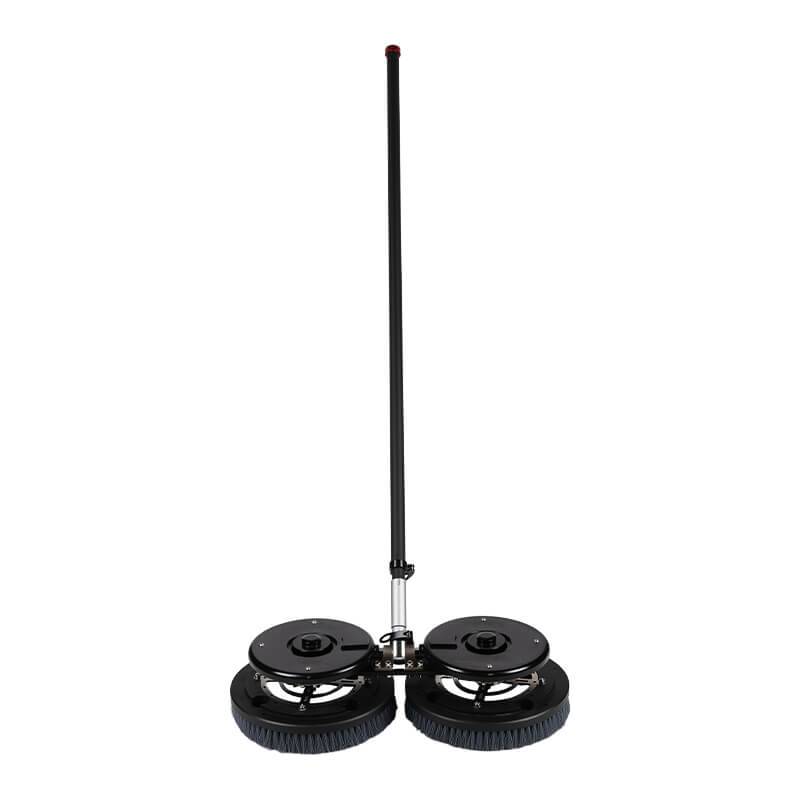
The Anbule Solar Panel Washing Machine is designed for professional use: a 710 mm dual brush head covers a wide path while a 600 W pump provides steady, low-pressure flow. A carbon-fiber telescopic handle keeps the unit light and easy to position, speeding cycles while protecting modules.
The rise of automated and specialty machines like the Anbule unit highlights the need to balance strong cleaning action with measures that prevent panel wear or damage.
Automated Solar Panel Cleaning: Efficiency & Damage Prevention
Dust and soiling can sharply reduce PV output, prompting development of automated cleaning robots to maintain array performance. While such robots help preserve efficiency and lower manual risk, deployment must prioritize cleaning effectiveness alongside the potential for mechanical wear or material degradation on module frames and surfaces.
Analysis of an automated solar panel cleaning robot on photovoltaics (PV) module frames with composites materials, Murshiduzzaman, 2025
What Are the Key Components of Professional PV Cleaning Systems?
Professional setups combine a few reliable parts to deliver safe, repeatable cleaning. Knowing these components helps match equipment to site conditions.
- Cleaning Brushes: Sized and specified to remove contaminants without scratching glass or damaging coatings.
- Water Supply System: Filtered, often deionized water prevents deposits and spotting; filtration and delivery determine streak-free results.
- Telescopic Poles: Enable ground-based access to elevated arrays, reducing ladders or scaffolding and improving safety and speed.
What Role Do Carbon Fiber Telescopic Poles Play in Solar Panel Cleaning?
Carbon fiber poles are strong, lightweight and resistant to bending, making them easy to extend to high or sloped panels and useful for manual and semi-automated workflows.
How Are Large-Scale Solar Panel Cleaning Operations Conducted?
Utility-scale cleaning requires planning, crew coordination and the right mix of equipment to minimize downtime and cost while maintaining safety.
- Planning and Scheduling: Account for weather windows, tilt, soiling patterns and downtime constraints.
- Team Coordination: Assign roles, follow mapped sweep patterns and run safety checks to avoid missed areas.
- Equipment Utilization: Select robots, semi-automatic units or ground-based rigs based on layout, soiling severity and budget.
Get a Custom Solar Panel Washing Machine Quote from Anbule
What Advantages Do Semi-Automatic Systems Offer Over Manual and Robotic Methods?
Semi-automatic systems combine operator control with mechanized cleaning to reduce labor while allowing real-time adjustments for pressure, brush speed and pattern.
- Labor Savings: Lower staff needs compared with manual cleaning while retaining oversight.
- Flexibility: Operators fine-tune settings to match site conditions.
- Cost-Effectiveness: Cheaper than full-robotic systems but more efficient than hand cleaning for medium arrays.
What Are the Benefits of Using Automated Solar Panel Cleaning Solutions?
Automation reduces manual effort, delivers consistent cleaning across large arrays and helps protect long-term yield.
- Increased Energy Output: Regular cleaning keeps panels closer to rated performance, improving energy production over time.
Research emphasizes that autonomous cleaning robots play a key role in protecting PV efficiency, particularly where dust and soiling cause significant energy loss.
Autonomous Solar Panel Cleaning Robots for Optimal PV Efficiency
This study traces solar-cleaning robot development from early prototypes to current designs, driven by the need to combat dust and soiling. The authors found that soiling can reduce system output—by as much as 30% in some cases—and concluded that responsive, automated cleaning tied to real-time data can help manage accumulation and minimize energy loss.
Prototype Optimization of Autonomous Solar Cleaning Robot, 2025
- Reduced Maintenance Costs: Automation cuts recurring labor and lets technicians focus on inspections and repairs.
- Consistent Cleaning Quality: Robots and automated rigs apply uniform processes to reduce missed spots and crew variability.
How Do Double Brush Head Technologies Improve Cleaning Performance?
Double brush heads increase contact area and widen the cleaning swath, removing more debris per pass and shortening total cleaning time to boost throughput on large sites.
For questions about professional solar panel cleaning solutions, or to learn more about products like the Anbule Solar Panel Washing Machine, you can contact our team.
Routine cleaning preserves energy output and extends equipment life. Selecting the right tools and understanding components lets operators optimize performance while managing cost; automated and semi-automated options add efficiency for larger arrays.
What’s Used to Clean Solar Panels | FAQs
What factors should be considered when choosing solar panel cleaning equipment?
Consider installation size, array layout, soiling type and frequency, access constraints and water quality. Balance cost, coverage and safety when choosing between manual, semi-automatic and automated systems.
How often should solar panels be cleaned for optimal performance?
Frequency depends on local conditions. Inspect panels regularly and clean at least twice a year; increase intervals in dusty, pollen-heavy or bird-prone areas.
Are there any risks associated with manual solar panel cleaning?
Yes — fall hazards and improper techniques can cause injury or module damage. Avoid harsh chemicals and high-pressure washers; use trained technicians or automated methods where practical.
What maintenance is required for cleaning equipment used on solar panels?
Inspect brushes, hoses, seals, filters and pumps regularly, replace worn parts, and follow manufacturer service schedules to keep equipment reliable.
Can solar panel cleaning equipment be used in all weather conditions?
Most equipment works best in mild, dry weather. Avoid high winds, heavy rain or freezing temperatures for safety and effectiveness.
What are the environmental impacts of solar panel cleaning solutions?
Impacts vary: deionized water reduces runoff, and automated systems can be more water-efficient. Consider energy use of robots and adopt water-efficient practices to lower the footprint.
Conclusion
Effective cleaning is a small but vital part of maintaining solar system productivity. From water-fed brushes and low-pressure washers to semi-automatic rigs and robots, choose equipment based on site size, soiling and budget while prioritizing methods that protect modules. If you’d like to explore professional cleaning options or discuss the Anbule Solar Panel Washing Machine, our team is ready to help.
 English
 Deutsch
 Français
 Polski
 Português do Brasil
 Español
 日本語
日本語 Русский
 العربية
 Italiano
 Nederlands
 Türkçe
 한국어
한국어